
Provisional
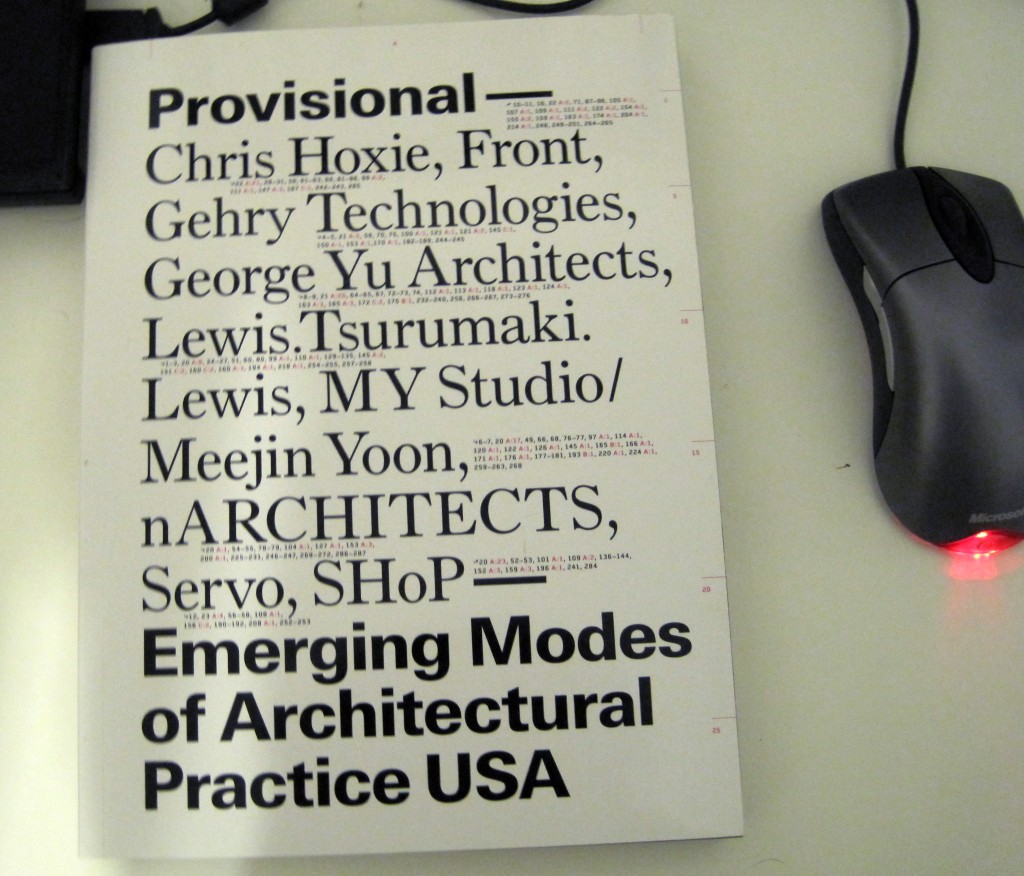
A new book edited by authors Elite Kedan, Jon Dreyfous, and Craig Mutter surveys a coming wave of innovative design practices attempting to reshape not only what we build, but also the how of the underlying design process. Some of the firms profiled, such as SHoP and Lewis.Tsrumaki.Lewis (LTL), expand the boundaries of the architect’s role by exploring new approaches to firm organization or the design process. Others break through those traditional professional expectations completely; Meejin Yoon Studio is as likely to create an exhibit design as they are a fashion line. Consultant practices like Front and Gehry Technologies take an opposite tactic by capitalizing on our society’s tendency towards specialization, focusing on particular segments of the building industry such as facade systems or digital software tools. They use their specific expertise to make other people’s designs build-able.
The book’s physical form, too, is a composite of multiple ingredients. A mixture of interviews, construction footage, blueprints, glossy renderings and even anecdotal snapshots are sandwiched between a series of theoretical essays anchoring the narrative’s beginning and end. The resulting book is unusually attractive as a material object, its lime green interview pages interspersed with the grey and white sediment of other informational types.
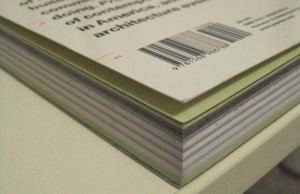
The layered mass hides further secrets. Intertwining through its structure is an ambitious navigational system, one which aims to inject the hyperlinked interconnectivity suggested by new forms of media into the book’s older medium of print. Each page is divided into a grid of numbers, as though it were part of some strange atlas.
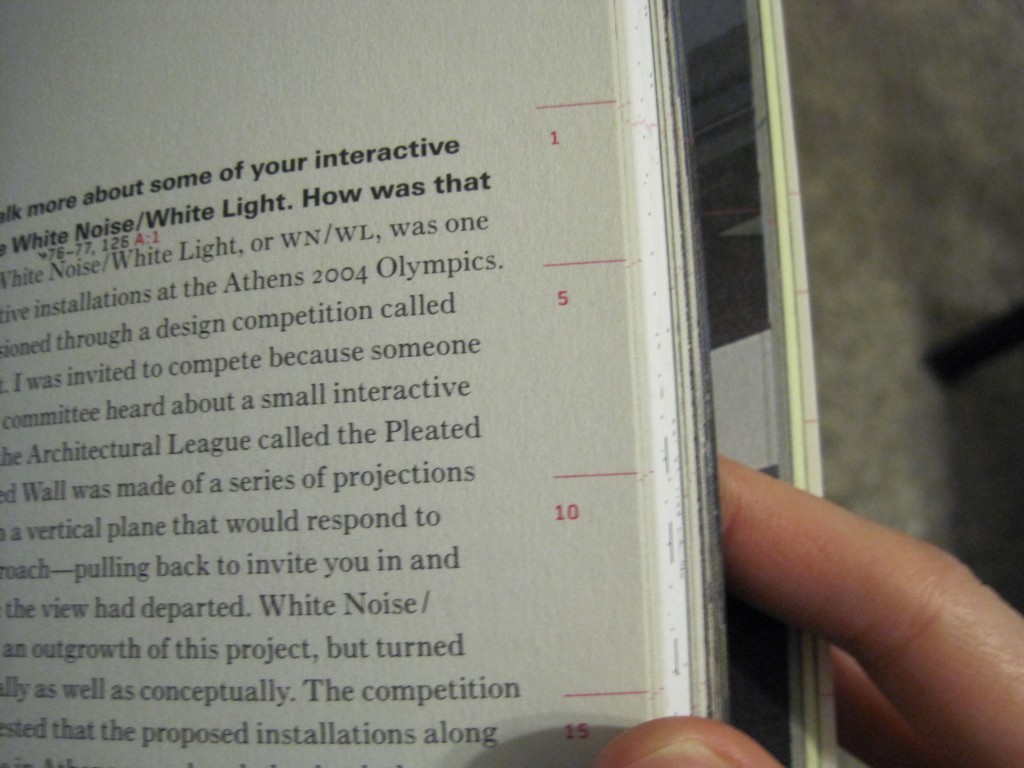
Sets of coordinates appear every time a key topic is mentioned, giving the reader a non-linear option for navigating the text.
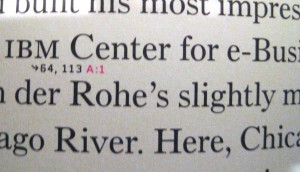
The concept remains primarily effective as a thought experiment. The potential complexity of the system is limited by the boundaries of the printed page, and as a result it is not comprehensive enough. I frequently found myself wishing for links where none existed. When one interviewee referred to a building that he had completed, I found myself yearning to be able to flip to a picture of it, or at least see more information. Instead I had to put the book down in order to go dredge the depths of Google on my computer. The inclusion of a more conventional index would have improved the accessibility of whatever information networks might currently be transcending its pages.
The featured architects show a more pragmatic outlook towards their own design projects. In spite of the high levels of technology involved, these designers share a common tendency to forgo pre-recession sculptural heroics in favor of today’s status quo. LTL claims to seek opportunities from within their design constraints, while SHoP admires the practical values of Australian sustainability guru Glenn Murcutt. One ultimately obtains the impression that these architects are willing to appropriate or adapt anything, so long as it can be built. As the book’s authors ultimately conclude, “there is nothing essentially subversive or avant-garde” about the ideas of the profiled firms. “The point, after all, is to build.”
The book itself, on the other hand, shows more interest in thoughts, or perhaps images, than in actions. Although the authors’ interview questions occasionally reveal the kind of telling glimpses into the profession’s trenches suggested by the book’s practice-oriented marketing and candid construction photography (example: “What are some of your biggest failings?”), the discourse ultimately can’t stay grounded for very long before it inevitably floats back into the realm of ideas.
Which raises the question of what, exactly, these architects’ theories mean. Are their adaptations to the profession’s practical demands really an enlightened achievement, as suggested by LTL’s intricate rationale for their zen-like embrace of design constraints, or simply an elaboration on existing conventional tactics for staying financially afloat?
Some other reviews of the book can be found on Archidose, anArchitecture, Dexigner, and Architectural Scholar.
Provisional‘s entry in the portfolio of the book designer, Project Projects.